An account compiled by Richard Tollett from
Newspaper cuttings, Lifeboat Station history and
local memories.
About every 10 – 15 years the RNLI Lifeboats
around the coast of Britain and Ireland are
replaced with new boats as a matter of course.
Some Stations stay with the same class of boat
and others are upgraded to the new improved
versions of what they have had, or downgraded to
a more suitable class to carry out the work that
they have been doing with the old boat. It is
traditional for crews to be asked for their
input on what type of boat is to be supplied.
In May of 1914 a new Lifeboat was offered to Rye
Harbour to replace the “John William Dudly” a
self-righting 10 oar Pulling and Sailing
Liverpool class in service since 1900. At the
invitation of the Institution the then Coxswain,
William Southerden and two of the crew were
invited to visit three Lifeboat Stations and
inspect the different types of boats, doing
similar work to that of the Rye Harbour boat.
The one that was chosen was a 38ft Liverpool non
self-righting pulling and sailing boat with 14
oars. This was thought to be the ideal craft to
operate in the surf conditions of Rye Bay.
J.E. Saunders of East Cowes was the builders and
on the 13th April 1916 she was tested
for draught and stability and found to be
‘perfectly satisfactory’. The cost of the
Lifeboat was met by a legacy in Memory of Mary
Stanford after whom the boat was named. The
Lifeboat was sailed from East Cowes and was
placed on Station at Rye Harbour on the 19th
October 1916. On the 25th November of
that year she was launched on exercise in
weather conditions that ‘fairly tested her’. The
Coxswain, crew and Officers of the Institution
were satisfied with the result of the exercise.
In 1920 the RNLI sent out a circular to all
Lifeboat crews’ around the Country asking what
type of Lifebelt was preferred. The crew at Rye
expressed a preference for the No 3
Lifebelt – the KAPOK. Exhaustive experiments had
been made up to September 1917 by the
Institution, with co-operation with the Board of
Trade and their officers, to ensure that Jackets
of No 3 pattern fulfilled the
purposes for which they were designed. The belts
had fulfilled the purposes under the conditions
of the experiment.
During her time at Rye Harbour the Mary Stanford
was launched 63 times, 47 launches were
exercises and 16 were shouts. From these 16
shouts, 10 lives were saved. One of these was
quite spectacular for the time. On the 12th
December 1923 an Aeroplane ditched in the sea
off Fairlight the Lifeboat towed the plane back
to Station, unfortunately the pilot an American
L.B. Sperry was lost when he had tried to swim
ashore before the Lifeboat arrived on scene.
During her time she had three Coxswain’s William
Southerden who took delivery of her in 1916 and
was Coxswain until 1919.He was followed by
Joseph White until 1924, when Herbert Head took
over from 1924 to 1928. The Lifeboat exercised
as usual and there were no real eventful
Services.
On the night of the 14th November
1928 a SW gale swept up the Channel with winds
in excess of 80 MPH. Just after 4 o’clock in the
morning of the 15th, the small
Steamer “Alice of Riga” laden with a cargo of
bricks is in collision with the larger German
Vessel “Smyrna”. In the collision the “Alice”
lost her rudder and had a hole torn in her side.
The weather was too bad for the “Smyrna” to
affect a rescue, and at 4.30AM North Forland
Radio received the following message. “Steamer.
Alice of Riga. Leaking. Danger. Drifting SW to W
8 miles from Dungeness 04.30” The Rye Harbour
Coast Guard Station was informed at 04.50 and
the Lifeboat maroons were fired. This put into
action the most devastating chain of events to
befall the Small Village of Rye Harbour. As soon
as the maroons were fired most of the Village
were awakened and could hear the ferocity of the
raging storm outside. Fred Southerden recalled,
as a lad he had heard his brother Charlie tumble
out of bed, Fred called to him saying that he
had ‘only heard one maroon’. Charlie replied
“best go someone may need help”. Such was the
will and spirit shown by all of these volunteers
that morning both crew and launchers. The
local’s that can remember that fateful morn, to
this day tell of how difficult it was to stand
up in the wind, let alone make the 1 mile
journey against the wind and rain to the
Boathouse out on the Shore.
The maroons were fired just after 5 am, it was
practically low water and it took three attempts
to get the boat away, the time now was 06.45, as
the boat went away. All of the crew by now would
have been wet through. It was just beginning to
break daylight, when at 06.50 Rye Coastguard
received the message saying that the crew of the
‘Alice of Riga’ had been rescued by the ‘Smyrna’
Frantic efforts were made by the Signalman to
recall the Lifeboat all to no avail, with the
blinding spray and driving rain coupled with all
of the action going on in the Lifeboat, keeping
her head to sea with the oars while the mast and
sails were raised. A very intensive time, no
wonder the flares were not seen.
At around 09.00 the mate of the S.S. Halton saw
the Lifeboat 3 miles W.S.W from Dungeness and
all appeared OK. The Lifeboat was also seen by a
boy sailor on the SMYRNA a bit later on. About
10.30 a young lad, Cecil Marchant, collecting
drift wood at Camber saw the Lifeboat capsize.
As he looked out to sea he saw it happen in a
bright shay of sunlight. He ran home and told
his parents what he had seen, and promptly got a
clout for making up stories but just to be on
the safe side his Father reported it to Jurys
Gap Coastguard. Soon rumours were going around
Rye Harbour Village that the boat had gone over,
the Vicar thought that he had seen this from an
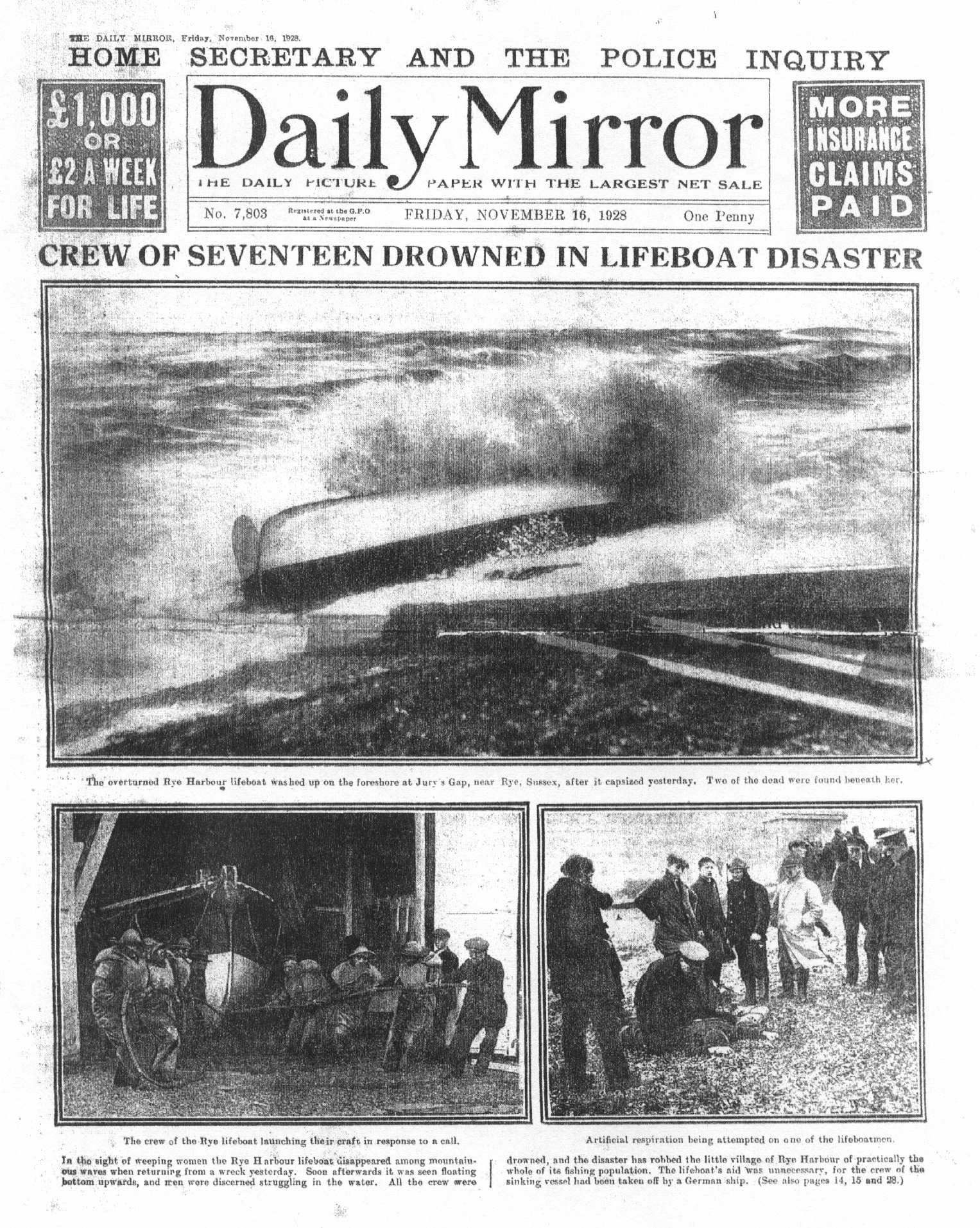
upstairs window at the Vicarage. By 12 noon it
had been confirmed as the Lifeboat could be seen
bottom up floating towards the shore. Within ten
minutes Rye Harbour Coastguard was informed and
the maroons were fired to assemble the
launchers. The Vicar went out on to the beach
and broke the news to the launchers. One young
woman Elsie Downey had been asked by her blind
mother repeatedly to go to the huts (by the Flag
Pole) for news of the boat. Elsie’s Brother
Arthur and cousin Morris were both in the boat
that day. Her Mother then asked her to run to
Rye (there was no bus in those days) and tell
her sister Lou the bad news. It is said that
over 100 men were rushed to the shore where the
upturned Lifeboat lay. No effort was spared in
trying to revive the bodies washed ashore. A
tank was brought along from Lydd Camp to right
the Lifeboat. Over the next two hours the bodies
of the crew were washed up. A total of 15 on
that day, they were taken to Lydd for formal
identification.
Eva Southerden, 15 at the time, remembers her
Father William, returning home that night and
breaking down in tears as he told his wife he
could not see Charlie (Charlie was found later
that night). Henry Cutting’s body was washed
ashore at Eastbourne three months later. The
body of John Head has never been found.
Speculation was rife as to the cause of the
capsize. It was said that the Lifejackets were
water logged and had drowned the crew due to the
weight The main point of conversation was what
was the Lifeboat doing in the position where it
capsized. It had no need to be there, it is most
unlikely that it was making for Rye Harbour, as
the Boathouse is 1 mile to the West, also in
these prevailing weather conditions, it was
usual for the Lifeboat to shelter East of
Dungeness or go into Folkestone.
The popular view was that either John Head or
Henry Cutting, or indeed both had been washed
out of the boat and that the Lifeboat was in
actual fact looking for them. This scenario
could be the answer as to why the Lifeboat was
in that position, but we shall never know. On
the evening of the following day an Inquest was
opened at Rye Town Hall, with the Rye Borough
Coroner Dr. T. Harrett presiding. The sea
worthiness of the Lifeboat and competence of the
crew were called into question, but it was
emphatically stated that the boat and her crew
were absolutely efficient. After evidence of
identification and eye witness accounts were
given, the Inquest was adjourned until the
following evening. On the following evening,
accusations were made about the suitability of
the Lifejackets. They were said to be perished
and worn. As a result they had become water
logged and would weigh a man down and drown him.
In response the RNLI stated KAPOK N o
3 Lifejacket was adopted by the RNLI in 1917 and
were delivered to Rye Harbour in September of
that year. The Lifejackets were tried in a heavy
gale on the 30th October 1917, and
later voted 11 – 6 by the crew as being the most
preferred type. The Coroner recorded a verdict
of death by accident. In response to the
accusations, the RNLI asked the Board of Trade
to hold a full enquiry into the disaster. On
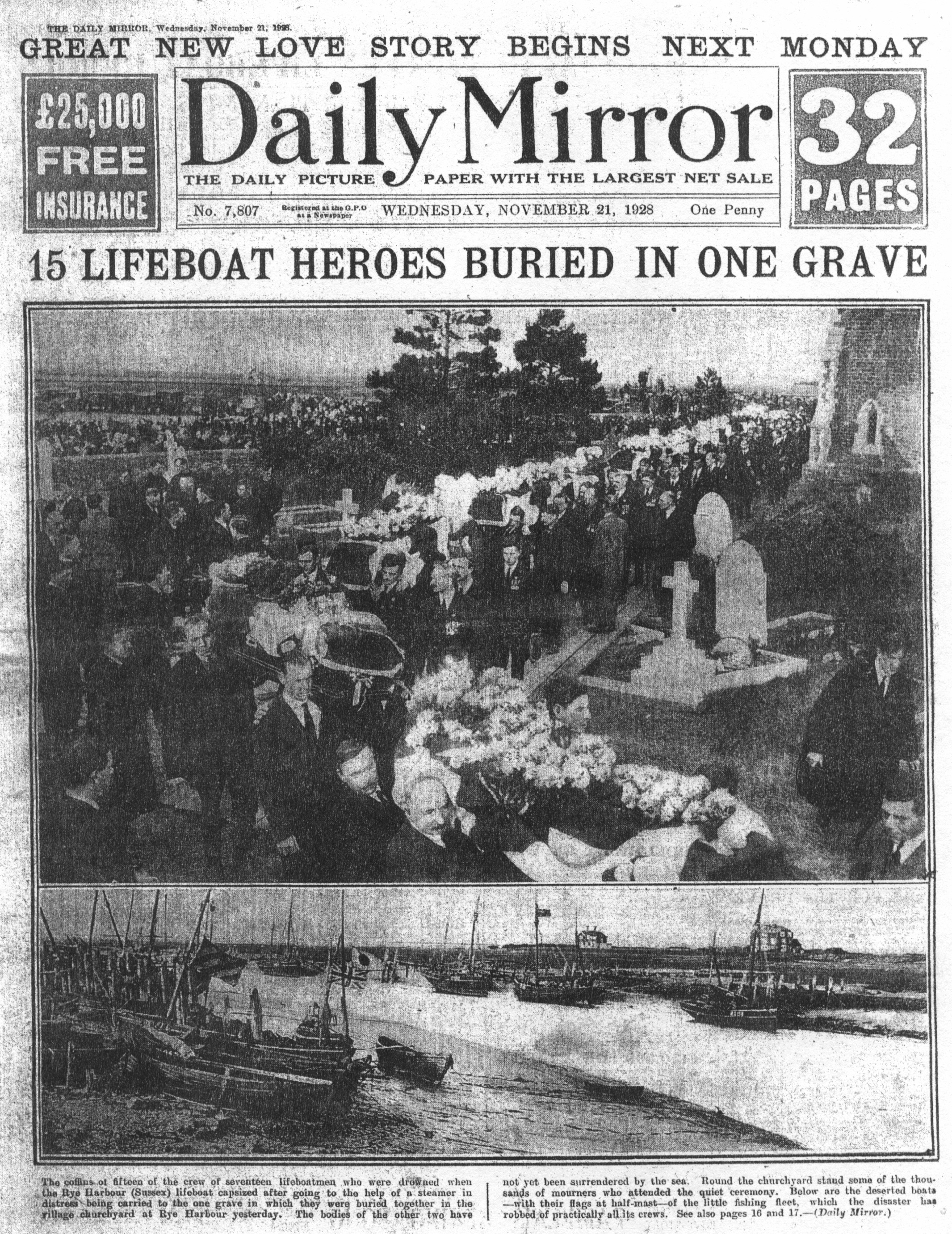
Tuesday the 20th November the funeral
was held. 15 of the crew were buried in a
communal grave on that day. When Henry Cutting’s
body was found at Eastbourne 3 months later, it
was bought back home to be interred in the
communal grave with his fellow crew members,
sadly, John Head’s body was never recovered.
Hundreds of mourners from all over the Country
attended. Members of the Latvian Government were
among the dignitaries present, in recognition
that the men had lost their lives going to the
assistance of a Latvian Vessel. The crew of the
Mary Stanford had grown up together, worked and
laughed together and were buried together. The
Board of Trade Court of Enquiry sat at Rye Town
Hall on December 19th, 20th
and 21st 1928 and January 1st,
2nd and 4th 1929 and after
all their deliberation the court finally
announced:
“As there were no survivors of the crew, the
cause of the Lifeboat capsizing is a matter of
conjecture, but from the evidence available we
are of the opinion that whilst attempting to
make the Harbour on a strong flood tide and in
high and dangerous breaking sea, she was
suddenly capsized and the crew were thrown into
the water, two men being entangled under the
boat. The broken water and heavy surf caused the
loss of the crew”.
The Mary Stanford was eventually taken to RNLI
depot at Poplar in east London, where she was
dismantled and broken up.
Compiled by Richard Tollett
For Rye Harbour Newsletter
****
Click on images to enlarge